Enterprise AI Agent Deployment Risks — and How to De-Risk Them
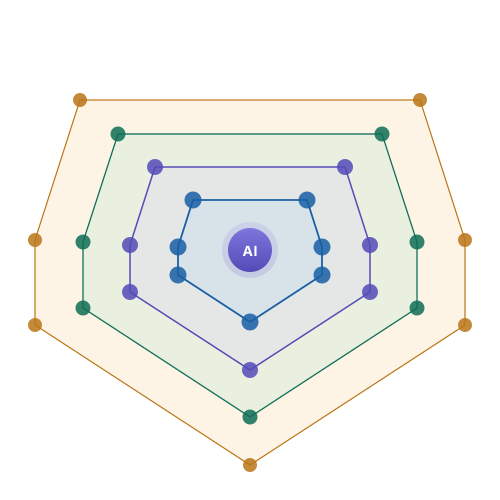
Enterprise AI agent deployment risks fall into six areas: security, cost, quality, provenance, reliability, governance. A practical way to de-risk each.
The risk is rarely the capability
By 2026 the question is no longer whether AI agents can do useful enterprise work. They can. The question that decides success is whether an organisation can deploy them without creating a security incident, a runaway bill, or a compliance gap that shows up in an audit. Enterprise AI agent deployment risk is an operational discipline, not a capability limitation.
Industry analysts have been blunt about this: a substantial share of agentic AI projects are expected to be shelved, and the reasons cited are rarely “the model could not do it”. They are unclear value, unmanaged cost, and unaddressed risk. Agents that dazzle in a demo fail in production because production exposes the risks the demo hid.
This post maps those risks into six categories and gives a practical de-risking move for each. It is written for the leader who has to sign off on the deployment, not just the engineer building it. For the layers underneath, see the AI agent infrastructure stack.
Risk 1: Security — the agent as attack surface
An AI agent with tool access is an autonomous actor inside your systems. It can read data, call APIs, and take actions using its own permissions. If an attacker can bend the agent’s reasoning — through prompt injection buried in a document, a poisoned tool response, or data smuggled through a side channel — they inherit a proxy with the agent’s full access.
Traditional application security assumes a human user working through a defined interface. Agents break that assumption. Standard penetration testing does not cover prompt injection chains, tool over-permissioning, or reasoning manipulation, which is why so many teams believe they are covered when they are not.
De-risk: scope every tool to least privilege, and run an agent-specific security assessment before launch, not after an incident. AI agent security assessment uses a red-teaming methodology aligned to the OWASP LLM Top 10 and MITRE ATLAS to probe exactly the vectors ordinary pentests miss.
Risk 2: Cost — spend you cannot see
Agents are expensive in ways a pricing calculator will not show you. A single agent task can trigger many model calls, tool invocations, and retries. Verbose prompts, redundant context, and dead-end reasoning chains inflate token consumption. Multi-turn conversations grow in cost faster than linearly as the context window fills.
The danger is not that agents cost money — it is that the cost is invisible until the monthly bill arrives, by which point the waste is baked in. Budgets for agentic projects are routinely underestimated, and cost overruns are among the most common reasons projects get cancelled.
De-risk: instrument cost per call from day one. Attribute spend to features and teams, route simple tasks to cheaper models, cache repeated prompts, and set budget alerts. AI FinOps tooling wraps existing Anthropic and OpenAI calls with drop-in Python and Node.js SDKs, so you get attribution and anomaly detection without re-architecting. Teams that measure their spend find the waste immediately.
Risk 3: Quality — vulnerable AI-generated code
The enterprise agent economy runs on AI-generated code, and a meaningful share of AI-generated code ships with security weaknesses. Code that passes functional tests can still carry injection flaws, hardcoded secrets, and insecure defaults. When an agent both writes and deploys code autonomously, a quality gap becomes an automated vulnerability factory.
The problem is worse where non-developers are building with AI assistance — a growing population inside enterprises — because they lack the security instinct to catch what the model gets wrong.
De-risk: put a quality gate between generation and deployment. Quality assurance for AI-generated code runs parallel agents that scan for security holes, architecture debt, dependency risks, and test gaps, and returns an A–F score in under a minute — fast enough to sit inside a pipeline rather than block it.
Risk 4: Provenance — knowledge you cannot audit
An agent answering from stale or unattributed knowledge is a quiet risk that surfaces at the worst moment: in front of a regulator, a customer, or a court. If you cannot show which sources informed a decision and whether they were current, you cannot defend the decision.
This is acute in regulated sectors. Under frameworks such as the EU AI Act, India’s DPDP, and sector rules like FINRA and HIPAA, the ability to produce an evidence trail is not optional.
De-risk: monitor the provenance of what your agent knows. AI provenance monitoring provides continuous source attribution, decay detection, and hash-signed evidence packs designed for exactly these reviews — so the audit trail exists before anyone asks for it.
Risk 5: Reliability — silent failure at length
Long-running, multi-step agent tasks fail in ways short chatbot interactions do not. A tool times out, a sub-agent returns garbage, a retry loop spins — and if the orchestration is naive, the task hangs or completes wrongly without anyone noticing. Reliability risk is the risk of confident, silent wrongness.
De-risk: build on durable orchestration that persists state, bounds retries, and surfaces failures rather than swallowing them. Keep a human in the loop for high-consequence actions — payments, deletions, external communications — until the reliability data justifies removing them. Autonomy is earned incrementally, not granted on day one.
Risk 6: Governance — unclear ownership
The final risk is organisational. Who owns the agent’s behaviour? Who is accountable when it acts wrongly? What is logged, retained, and reviewable? Many teams deploying agents lack a clear governance model, and the absence only becomes visible after something goes wrong.
De-risk: assign a named owner for every production agent, define what it is and is not permitted to do, log its actions in a form that can be audited, and review incidents the way you would review any production failure. A lightweight governance model in place from the start beats a heavyweight one written after an incident. There is a fuller treatment in our governance framework for non-technical leaders.
Putting it together: a de-risking checklist
The six risks are not independent — they compound. An exploited agent (Risk 1) generates runaway cost (Risk 2). Vulnerable code (Risk 3) becomes a security incident (Risk 1). Weak governance (Risk 6) hides all of the above. So the de-risking moves have to be adopted together, not picked à la carte.
A workable pre-launch checklist for any enterprise agent:
- Tools scoped to least privilege, with write access justified case by case.
- Agent-specific security assessment completed and findings remediated.
- Cost-per-call instrumentation live, with budget alerts configured.
- AI-generated code gated through quality assurance before deployment.
- Provenance monitoring in place for any regulated knowledge.
- Human-in-the-loop retained for high-consequence actions.
- A named owner, an action log, and an incident review process.
None of these is exotic. What separates the deployments that survive from the ones that get cancelled is simply doing them before launch rather than after the first incident. The capability is the easy part. De-risking is the work.
If you are preparing an enterprise agent for production and want a risk review before you ship, email atin@aivyuh.com or book a 30-minute call.
Part of AI Vyuh’s coverage of the AI agent economy — security, code quality, cost, and provenance for teams deploying AI agents in production.