An AI Agent Governance Framework for Non-Technical Leaders
An AI agent governance framework for non-technical leaders: five questions, four control areas, and an operating cadence for deploying agents safely at scale.
Governance is a leadership question, not just a technical one
If your organisation is deploying AI agents, someone senior will eventually have to answer for one. When an agent takes an action that costs money, touches customer data, or produces a decision a regulator questions, the answer “the model did it” will not hold. Governance is the discipline that lets a leader answer for an agent with confidence — and it does not require reading a line of code.
This matters because a large share of organisations deploying agents lack a clear governance model, and only a minority have anything mature. That gap is not a technical problem the engineers will quietly solve. It is a leadership responsibility, because governance is about accountability, permissions, and evidence — the vocabulary of leadership, not of code.
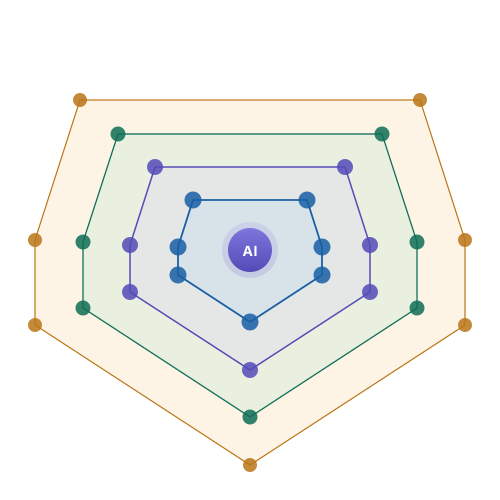
This framework is deliberately built for the non-technical leader. It is five questions you should be able to ask of any production agent, four control areas that answer them, and an operating cadence that keeps the answers current. It complements the risk view in enterprise AI agent deployment risks.
The five questions every leader should be able to answer
You do not need to understand transformers to govern an agent. You need to be able to answer five questions about every agent your organisation runs. If you cannot, that is the governance gap made visible.
- Purpose. What is this agent for, and what is it explicitly not for? An agent without a bounded purpose is an agent that will eventually do something no one intended.
- Permissions. What can it access and act on? Which of those permissions involve real money, real data, or irreversible actions?
- Ownership. Who is the named human accountable for this agent’s behaviour? “The AI team” is not an owner. A person is.
- Oversight. For high-consequence actions, is a human in the loop? Under what conditions does the agent act alone?
- Evidence. If someone asks what the agent did and why, can you produce a record? Within what time and to what standard?
These five map cleanly onto what boards, auditors, and regulators actually ask. A leader who can answer all five is governing. A leader who cannot is hoping.
The four control areas
Answering the five questions in practice requires four categories of control. Each is a place where the answer either exists or is a gap.
Security
An agent with tool access is an autonomous actor in your systems, and the attacks against it — prompt injection, tool poisoning, permission escalation — are not covered by traditional security testing. The control is agent-specific assessment.
You do not need to run it yourself, but you should be able to say when it was last done and what it found. AI agent security assessment provides red teaming and vulnerability assessment built for agentic systems, mapped to recognised standards, so the answer to “have we tested this?” is a date and a report rather than a shrug.
Cost
Every agent action consumes tokens, and token spend is invisible until it is a problem. The control is cost visibility: per-call attribution, anomaly detection, and budget alerts. A leader should be able to state what an agent costs to run and be warned before that cost spikes. AI FinOps tooling provides that visibility by wrapping existing model calls, so the finance answer is a number, not an estimate.
Quality
When agents generate and deploy code, the quality of that code becomes a governance concern, because a meaningful share of AI-generated code ships with security weaknesses. The control is a quality gate. Quality assurance for AI-generated code scores generated code before it ships, so “is the code the agent writes safe?” has an auditable answer.
Provenance
For any agent whose decisions rely on knowledge — policies, prices, regulations — you must be able to show which sources it used and whether they were current. The control is provenance monitoring. AI provenance monitoring tracks source attribution, detects stale knowledge, and produces evidence packs designed for regulatory review — turning “prove it” into a document you can hand over.
Matching oversight to consequence
Not every agent needs the same governance weight. Applying heavy controls to a trivial agent wastes effort; applying light controls to a consequential one invites disaster. Governance should be proportionate to consequence.
A simple tiering helps a non-technical leader make this call without technical detail:
| Tier | Consequence of a wrong action | Oversight posture |
|---|---|---|
| Low | Reversible, low-cost, no sensitive data | Monitor after the fact; light logging |
| Medium | Costs money or touches internal data | Attribution, alerts, periodic review |
| High | Irreversible, external, or regulated | Human-in-the-loop, full assessment, evidence trail |
The tiering exercise itself is valuable. Forcing each agent into a tier makes the organisation state, out loud, how much damage it could do — which is often the first time anyone has asked.
An operating cadence, not a one-time document
The most common governance failure is treating it as a document you write once and file. Agents change, tools change, the data they rely on ages, and new attack techniques emerge. Governance has to be a cadence.
A workable rhythm for a non-technical leader to sponsor:
- Before launch: confirm the five questions have answers and the four controls are in place at the agent’s tier.
- Monthly: review cost and any anomalies; confirm ownership is still valid as people move roles.
- Quarterly: re-run or refresh security assessment; review provenance for any regulated knowledge; re-tier any agent whose scope has grown.
- After any incident: treat it like any production failure — root cause, remediation, and a check on whether the framework should tighten.
None of this requires the leader to be technical. It requires the leader to insist that the questions have answers and the answers stay current. That insistence is the governance.
The cost of not governing
The failure mode is predictable. An ungoverned agent works well for months, then takes one action that no one scoped, no one owned, and no one can explain. The cost is not the single action — it is the loss of trust in the whole programme, and the freeze that follows while everyone scrambles to build the governance that should have been there.
Governance is cheaper before the incident than after it. For a non-technical leader, it comes down to a discipline that fits on one page: five questions, four controls, a tier, and a cadence. That is enough to deploy agents responsibly — and enough to answer for them when someone asks.
Frequently Asked Questions
Does a small team need a governance framework? Yes, but keep it light. Even a two-person team can answer the five questions and set a tier for each agent. The framework scales down; the accountability does not disappear because the team is small.
Who should own agent governance in an organisation? A named business owner accountable for outcomes, supported by whoever runs security, finance, and engineering. Governance that lives only in engineering tends to skip the cost and accountability questions that leaders care about most.
If you want help setting up a right-sized governance framework for your agents, email atin@aivyuh.com or book a 30-minute call.
Part of AI Vyuh’s coverage of the AI agent economy — security, code quality, cost, and provenance for teams deploying AI agents in production.