The AI Agent Infrastructure Stack: The Layers Every Production Agent Needs
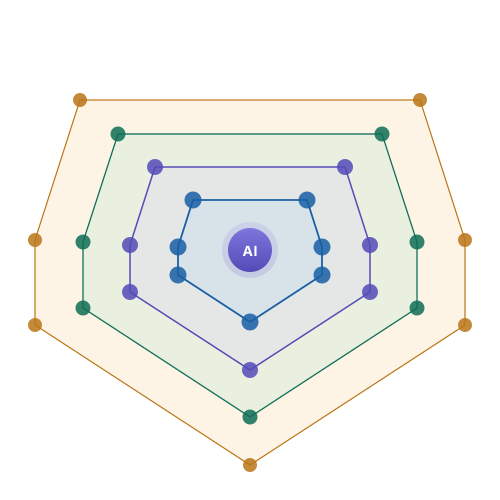
The AI agent infrastructure stack has five layers: model, tools, memory, orchestration, and governance. A practical map of what production agents need.
Why the stack, not the demo, decides whether an agent ships
Most AI agent projects die in the gap between demo and production. The demo is a single happy-path run in front of an audience. Production is a system that has to reason correctly, recover from failure, stay within budget, and not become an attack surface — thousands of times a day, unattended.
Bridging that gap is an infrastructure problem, not a prompting problem. The AI agent infrastructure stack is the set of layers every production agent quietly depends on, whether or not the team building it has named them. Get the layers right and the agent becomes boring and reliable. Skip a layer and the failure shows up later — usually as a cost blowout, a security incident, or a silent hang in a long-running task.
This post maps the stack the way an operator should think about it: five layers, what each one is for, where teams get it wrong, and how the governance layer ties the whole thing together. It builds on the broader picture in the AI agent economy.
Layer 1: The model — the reasoning engine
At the base sits the model: the large language model that does the actual reasoning, planning, and generation. Everything above it exists to make the model useful and safe.
The practical decisions here are rarely “which model is best” and more often “which model for which task”. A production agent almost never uses a single model. Routing simple classification or extraction to a smaller, cheaper model and reserving the frontier model for genuine multi-step reasoning is one of the highest-leverage architectural choices you can make. It affects latency, cost, and reliability at once.
Two things to settle early at this layer. First, the model is non-deterministic — the same input can produce different outputs — so every layer above must be built to tolerate variance rather than assume a fixed response. Second, the model is the part of your stack you control least; providers deprecate versions and change behaviour. Treat the model as a swappable component behind an interface, not a hard dependency baked into your business logic.
Layer 2: Tools — how agents act on the world
An agent that can only talk is a chatbot. An agent becomes an agent at the tool layer — the interfaces that let it browse the web, call APIs, query databases, run code, and act on external systems.
The dominant development here has been the emergence of open tool protocols, most visibly Anthropic’s Model Context Protocol (MCP), which has become a widely adopted standard for connecting agents to tools in a consistent way. Standardisation is a genuine step forward: it turns one-off integrations into reusable connectors.
But the tool layer is also where risk concentrates. Every tool an agent can call is a capability an attacker might hijack. Tool schemas consume a meaningful share of the context window, driving cost. Over-permissioned tools — an agent granted write access it never needed — are one of the most common and most dangerous configuration mistakes. Tool design is security design. This is precisely the surface that purpose-built AI agent security assessment exists to probe: prompt injection through tool inputs, excessive permissions, and unsafe tool chaining.
Layer 3: Memory and data — persistent context
Agents need to remember. Not just within a single conversation, but across sessions, users, and workflows. The memory and data layer provides that persistence.
In practice this is a combination of vector stores for semantic retrieval, structured databases for facts and state, and increasingly a dedicated memory service that tracks what the agent has learned and what the user prefers. Retrieval-augmented generation lives here: pulling the right context into the model at the right moment so the agent reasons over current, relevant information rather than the model’s stale training data.
The failure mode at this layer is subtle. Bad memory does not crash the agent — it quietly degrades its answers. Stale documents, contradictory sources, and unattributed context lead an agent to confidently assert things that were true last quarter and are wrong today. In regulated settings that is not a nuisance, it is a liability. Monitoring the freshness and provenance of what your agent knows is exactly what AI provenance monitoring is built to do — detecting knowledge decay, drift, and cross-source contradictions before they reach a user.
Layer 4: Orchestration — managing complexity
Single tool calls are easy. Coordinating a multi-step plan — with retries, branching, sub-agents, and durable state that survives a process restart — is hard. The orchestration layer is where that complexity is managed.
Orchestration frameworks handle workflow definition, state persistence, and inter-agent communication. Durable execution engines guarantee that a long-running task can pause, resume, and recover rather than failing silently halfway through. This matters because the gap between the architecture a team designs and the way an agent actually behaves at runtime is where costs hide. An agent designed to make a handful of model calls per task routinely makes many more once tool use, retries, and sub-agent delegation are counted.
The lesson operators learn the hard way: design for the runtime, not the diagram. A five per cent tool failure rate combined with naive retry logic quietly inflates your real call volume — and your bill. Build the orchestration layer to make that volume visible, bounded, and recoverable.
Layer 5: Governance — security, cost, quality, and provenance
The top layer is the one most teams add last and regret adding late. Governance is the set of cross-cutting controls that make an agent safe to operate in production. It is not one system; it is four concerns that must be handled together.
- Security. Agents with tool access are autonomous actors inside your systems. Prompt injection, tool poisoning, and permission escalation are live threats, and traditional penetration testing does not cover them. Agent-specific red teaming is the control here.
- Cost. Token spend is invisible until it is a crisis. Per-call attribution, model routing, and budget alerts turn an unpredictable bill into a managed line item. AI FinOps tooling wraps existing model calls to make spend visible without re-architecting anything.
- Quality. When agents generate and deploy their own code, quality assurance stops being optional. Quality assurance for AI-generated code catches the vulnerability patterns and technical debt that AI code introduces at speed.
- Provenance. In regulated environments you must be able to show which sources an agent relied on and whether they were current. That evidence trail is a compliance requirement, not a nicety.
These four are not independent. An exploited agent racks up runaway costs. Vulnerable AI-generated code becomes a security incident. Governance is the layer that makes the other four layers trustworthy.
How to sequence the build
You do not build all five layers at once, and you should not. A sensible sequence: start with model and tools to prove the agent can do the task; add memory once the task needs context; add orchestration the moment the task becomes multi-step and long-running; and layer in governance before — not after — you expose the agent to real users, real money, or real data.
The teams that ship durable agents treat governance as a first-class layer from day one, even if it is thin at the start. The teams that treat it as a phase-two clean-up are the ones that show up in the failure statistics.
The AI agent infrastructure stack is not a product you buy in one box. It is a set of deliberate choices at five layers, made in the right order, with the failure modes of each layer understood before they bite.
Frequently Asked Questions
Do small teams really need all five layers? Not on day one. A prototype can live on model and tools alone. But any agent touching real users, money, or regulated data needs memory, orchestration, and at least a thin governance layer before it goes live.
If you are building a production agent and want a second pair of eyes on the stack, I am happy to talk it through. Email atin@aivyuh.com or book a 30-minute call.
Part of AI Vyuh’s coverage of the AI agent economy — security, code quality, cost, and provenance for teams deploying AI agents in production.