Why AI Agents Need Their Own Security Assessment
Traditional pentests cover web apps and APIs. But AI agents introduce an entirely new attack surface that requires purpose-built testing methodology.
The problem with “we already pentest”
Every CISO we talk to says the same thing: “We already have a pentest program.” And they do — annual or quarterly assessments covering their web applications, APIs, and network infrastructure. The reports come back with findings mapped to OWASP Top 10, remediation gets prioritized, and the compliance box gets checked.
But here’s what those pentests don’t cover: the AI agents that are now making autonomous decisions, accessing tools, querying databases, and interacting with customers on behalf of the enterprise.
AI agents have a different attack surface
Traditional applications receive input, process it deterministically, and return output. AI agents are fundamentally different:
They interpret natural language instructions. This means an attacker doesn’t need to find a SQL injection point or an XSS vector. They can manipulate the agent through its primary interface — language. Prompt injection attacks exploit this by embedding malicious instructions within seemingly normal input.
They have tool access. Modern AI agents can call APIs, query databases, execute code, and interact with external services. If an agent’s tool permissions are overly broad — and they usually are — a successful prompt injection can cascade into data exfiltration, unauthorized actions, or lateral movement across systems.
They reason, and that reasoning can leak. AI agents maintain context across conversations. That context often contains sensitive information — customer data, internal configurations, system prompts with business logic. Adversarial queries can extract this information through careful conversational manipulation.
They make autonomous decisions. Unlike traditional software that follows explicit code paths, AI agents make judgment calls. An agent deciding to “help” a user by revealing configuration details isn’t a bug in the traditional sense — it’s a failure of the agent’s decision boundary.
What a purpose-built assessment looks like
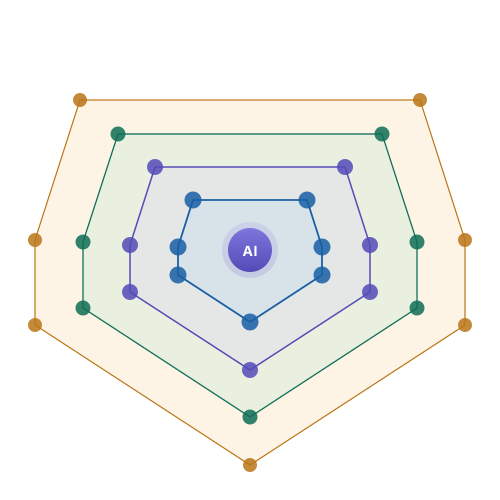
At AI Vyuh Security, we built a 7-agent automated red-teaming pipeline specifically for these attack vectors:
- Reconnaissance — maps the agent’s attack surface, catalogues endpoints, identifies tool access, and scores exposure risk
- Prompt Injection — tests 50–200+ payloads across direct injection, indirect injection, and multi-turn manipulation
- Credential Exposure — probes for secrets leaked through error messages, debug modes, and conversational extraction
- Tool Permission — tests whether the agent’s tool access exceeds what’s needed, and whether those permissions can be exploited
- Data Exfiltration — attempts to extract sensitive data through the agent’s responses, tool outputs, and reasoning chain
- Cross-Agent Trust — tests trust boundaries between agents in multi-agent systems
- Reporting — generates compliance-mapped findings with OWASP LLM Top 10, MITRE ATLAS, SOC 2, and ISO 27001 alignment
Every finding comes with severity ratings, CVSS scores, and actionable remediation guidance.
The 85% gap
Our estimate — based on assessments we’ve conducted — is that approximately 85% of the attack surface specific to AI agents is not covered by traditional penetration testing. Not because traditional pentesters are bad at their jobs, but because the tools, methodologies, and taxonomies they use were designed for a different class of software.
This isn’t about replacing your existing pentest program. It’s about extending it to cover the new attack surface that AI agents introduce.
When to assess
If your organization is deploying AI agents in any of these scenarios, you need a purpose-built security assessment:
- Customer-facing agents that handle queries, process transactions, or access personal data
- Internal agents with access to databases, APIs, or administrative tools
- Multi-agent systems where agents communicate and delegate tasks to each other
- Agents handling regulated data subject to SOC 2, ISO 27001, DPDP Act, or EU AI Act requirements
The cost of not assessing is not theoretical. Prompt injection attacks, credential exposure through agent conversations, and data exfiltration through tool manipulation are happening in production today.
Ready to find out what your pentest missed? Request an assessment at AI Vyuh Security →
Related reading
AI agent security doesn’t exist in isolation — code quality and cost visibility are part of the same risk surface. If your agents run on AI-generated code, the code quality crisis in AI-assisted development is compounding your security exposure with every deployment.
Curious what a purpose-built assessment actually uncovers? We red-teamed our own AI agent and found 2 critical vulnerabilities in a system we built ourselves. And if you’re shipping vibe-coded applications, the data on vibe coding security risks shows why traditional pentests miss 85% of the attack surface.